
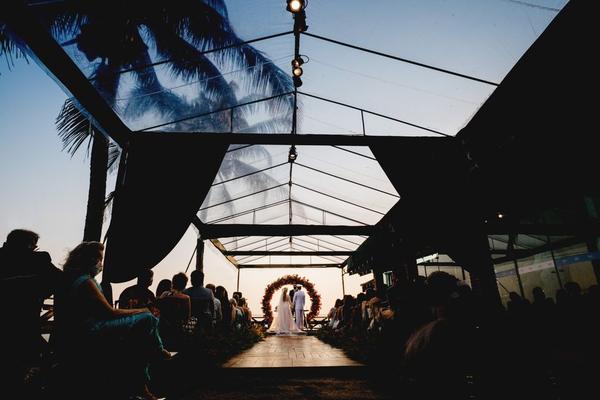
A wedding for 100 guests sits in a useful middle ground: large enough that catering, staffing, rentals, and drinks can move the total quickly, but small enough that you can still make deliberate choices without planning on a ballroom scale. The smartest way to build a wedding budget for 100 guests is to separate costs that rise with headcount from costs that stay mostly fixed.
For context, recent U.S. wedding data for 2025 put the average wedding spend at about $34,000 and the median at about $24,000. A 100 guest wedding cost can fall well below or above them depending on location, venue type, meal style, season, and how many professional vendors you hire.
Start With the Budget Formula, Not Vendor Shopping
A practical guest count budget begins with a simple equation: fixed costs + per-person costs + taxes and service fees + contingency. Fixed costs might include photography, entertainment, attire, ceremony fees, and some décor. Per-person costs usually include food, beverages, place settings, rentals, favors, and sometimes staffing.
This distinction matters because a venue may look inexpensive until the quote includes a food-and-beverage minimum, mandatory rentals, staffing, or a service charge.
Build a Realistic 100-Person Scenario
Suppose a couple is aiming for a medium wedding budget of roughly $30,000. They might reserve about $12,000 for the venue, meal, and nonalcoholic service; $3,000 for photography; $2,000 for music; $2,500 for attire and beauty; $2,000 for flowers and décor; $2,500 for alcoholic drinks; $1,000 for stationery and signage; $1,000 for cake or dessert; and the remaining amount for ceremony costs, transportation, tips, small purchases, and a contingency buffer.
That is an illustration, not a price guide. A downtown Saturday wedding can cost far more than a Friday event at a community hall, restaurant, or lower-cost venue.
Calculate the Costs That Change With Guest Count
Food and Catering
Catering is often the biggest variable expense. If food is quoted at $90 per person, 100 guests create a $9,000 food line before any applicable tax, service charge, rentals, or gratuity. At $130 per person, the same guest list becomes $13,000. That is why the wedding cost for 100 people cannot be estimated accurately from headcount alone; the chosen service level matters just as much.
Ask whether the per-person price includes cocktail-hour food, staff, china, flatware, coffee service, cake cutting, and cleanup. Two caterers with the same menu price can produce very different final invoices.
Drinks
Bar pricing may be charged per guest, per hour, by consumption, or as a package. A limited beer-and-wine bar can be materially different from a premium open bar, while a consumption model may work well for some groups but adds uncertainty.
Rentals, Stationery, and Small Guest Costs
Chairs, linens, table settings, printed menus, escort cards, favors, and welcome items can look inexpensive individually. Multiply even a $10 per-person detail by 100 guests and it becomes $1,000. Review these small categories together so they do not quietly crowd out higher-priority spending.
Separate Fixed Costs From Guest-Driven Costs
Photography is a good example of a mostly fixed cost. A photographer may charge a package price based on hours and deliverables, not whether 80 or 100 guests attend. The same can be true for a DJ, officiant, wedding planner, attire, marriage-license fees, and some floral installations.
This explains why cutting 10 guests does not automatically reduce the total budget by 10%. It may lower catering, drinks, rentals, and stationery, while leaving many major contracts unchanged. If you are deciding whether to reduce your list, calculate the true marginal cost per additional guest rather than dividing the entire wedding budget by 100.
For more planning context, a useful next step is reviewing a wedding budget percentage guide, a wedding catering cost breakdown, and a venue comparison checklist before signing major contracts.
Watch Vendor Minimums and Capacity Breakpoints
Medium-size weddings can run into thresholds that are easy to miss. A venue may require a minimum food-and-beverage spend regardless of whether 90 or 100 people attend. A rental company may price in delivery tiers. A caterer may need an extra server once the event crosses a certain guest count. Table layouts can also change if adding guests requires another table, linen, centerpiece, and set of chairs.
Ask each vendor what changes at 100 guests, 110 guests, or 90 guests.
Add Fees, Gratuities, and a Contingency Before You Commit
A quote is not always the final payable total. Review contracts for sales tax, service charges, delivery, setup, overtime, travel, cake-cutting fees, corkage, and mandatory staffing. Also confirm whether a service charge is distributed as gratuity; it is not automatically the same as a tip.
Keep a contingency fund of around 5% to 10% if your finances allow. Weddings often generate late-stage expenses such as alterations, additional rentals, vendor meals, weather backup, postage, or last-minute transportation. Building that margin at the start is far less stressful than finding it in the final month.
Use the Final RSVP Count to Tighten the Numbers
Your invited guest count and paid guest count may not be identical. Do not assume a certain decline rate when signing contracts. Instead, understand each vendor’s minimums, deposit schedule, and deadline for the guaranteed headcount. Once RSVPs close, update food, bar, rentals, stationery, and seating numbers with the actual attendance figure.
Frequently Asked Questions
How much should I budget for a wedding with 100 guests?
There is no single correct amount. Location, venue, catering style, bar service, season, and vendor choices can shift the total dramatically. Build the budget from local quotes, separating fixed expenses from per-person costs, rather than relying on a national average alone.
What is the biggest cost for a 100-person wedding?
For many weddings, the venue and food-and-beverage package is the largest combined expense. However, the balance can change if the venue is inexpensive but the couple spends heavily on photography, entertainment, florals, or design.
Does reducing the guest list always save a lot of money?
Not necessarily. It reduces guest-linked costs, but fixed vendor packages may stay the same. Savings are also limited when a venue or caterer has minimum spending requirements.
When should I finalize the guest-count budget?
Create the working budget before booking major vendors, then update it whenever you receive a firm quote. Do a final revision after RSVP deadlines and guaranteed headcounts are confirmed.
Plan Around the 100 Guests You Actually Want
A strong wedding budget for 100 guests is less about hitting a generic national number and more about understanding how your own celebration behaves financially. Price the fixed commitments first, calculate the true per-person additions, account for vendor minimums and fees, then protect the plan with a contingency. Once those pieces are visible, a medium-size wedding becomes much easier to control—and you can spend intentionally on the parts your guests and you will remember most.